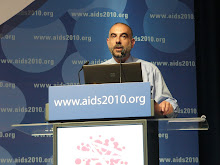
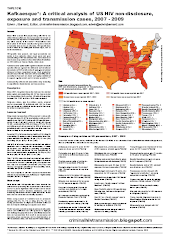
South African Supreme Court Justice Edwin Cameron's impassioned call for “a campaign against criminalisation” has been heard far and wide since he gave his plenary presentation on the final day of the XVII International AIDS Conference in Mexico City last month.
I have collected the various articles that have reported on Justice Cameron's plenary, as well as the five other sessions consisting of at least 20 different oral or poster presentations, many of which I previously reported on here. Several of the articles also include quotes from a press conference held in Mexico, which – strangely – took place at the same time as the main Wednesday session on criminalisation, and which I unfortunately missed.
They include a high profile article in The New York Times, as well as articles or editorials from Canada, Jamaica, Rwanda, South Africa, Uganda, and the United Kingdom. There was even coverage of the issue in The Diplomatic Courier, a publication from the United States that reports on diplomatic and security issues .
I also wrote a second piece for aidsmap.com, covering Justice Cameron's plenary in detail and several other sessions at the conference, which you can find here.
Seeking Better Laws on H.I.V.
by Lawrence K. Altman
New York Times
August 9, 2008
MEXICO CITY — The 17th International AIDS Conference ended here on Friday with a call for the reversal of laws that criminalize and stigmatize groups at risk for H.I.V., the virus that causes AIDS.
“Criminalization is a poor tool for regulating H.I.V. infection and transmission,” Edwin Cameron, a justice of the Supreme Court of Appeals in South Africa, said in a plenary session.
“Let one of the conference outcomes be a major international push-back against misguided criminal laws and prosecutions,” said Justice Cameron, who is himself infected.
Citing cases in Texas, Zimbabwe, Sierra Leone, Bermuda and Switzerland to illustrate the “folly of criminalization,” the judge said, “There is no public health rationale for invoking criminal law sanctions against those who unintentionally transmit H.I.V. or expose others to it.”
Justice Cameron said he understood that society feared the deadly virus and that public officials might want to invoke laws to counter those who recklessly passed it to others.
But, he said, “Criminalization is warranted only where someone sets out, knowing he has H.I.V., to infect another and succeeds.”
Justice Cameron cited the conviction in Dallas in May of Willie Campbell, 42, a homeless, H.I.V.-infected man who was charged with harassing a public servant with a deadly weapon after he spat at a police officer who arrested him.
Mr. Campbell must serve at least half of his 35-year sentence before he can apply for parole.
Justice Cameron pointed out that, according to the Centers for Disease Control and Prevention, saliva has never been shown to result in the transmission of H.I.V.
“The man was punished not for what he did, but for the virus he carried,” the judge said.
At the trial Mr. Campbell’s lawyer said he was indicted as a habitual offender, with a minimum penalty of 25 years, because he had been convicted of attacking two other officers in a similar manner and biting two inmates, as well as more than two dozen other offenses.
Justice Cameron described a law in Sierra Leone that requires a woman to take reasonable measures and precautions to prevent transmitting H.I.V. to her fetus. But testing for the virus and treatment for an infected mother are not widely available, health officials have said.
At least a dozen African countries have adopted similar laws, many poorly drafted, said the judge, who called them poor substitutes for measures that protected those at risk.
AIDS conference ends with call to end stigma
Ingrid Brown
Jamaica Observer
Monday, August 11, 2008
According to Edwin Cameron - a judge of the Supreme Court of Appeal of South Africa - the enactment of laws that criminalise transmission of or exposure to HIV had become so widespread, and criminal prosecutions so frequent, that they had become a crisis in efforts to deal rationally and effectively with HIV. "Rather, they radically increase HIV stigma and become barriers to testing and treatment," he said.
10 reasons why criminal laws and prosecutions make bad policy in the AIDS epidemic
Body Positive Northwest (UK)
On the final day of AIDS 2008 in Mexico City HIV positive Judge from South Africa's Supreme Court of Appeal, Edwin Cameron delivered a passionate lecture entitled HIV is a virus, not a crime.
Justice Cameron argued that the enactment of laws that criminalise transmission of or exposure to HIV has become so widespread, and criminal prosecutions so frequent, that they have become a crisis in efforts to deal rationally and effectively with HIV. Citing examples from locations as diverse as the United States, Sierra Leone and Singapore, Cameron highlighted the irrational nature of these laws and their ineffectiveness in achieving their purported goal of preventing the spread of HIV. Rather, they radically increase HIV stigma and become barriers to testing and treatment. Prosecutions often single out already vulnerable groups such as sex workers, men who have sex with men and, in European countries, black males. Women are especially victimised by these laws, which expose them to assault, ostracism and further stigma.
Cameron stated that one of the outcomes of AIDS 2008 should be a major international pushback against such misguided criminal laws and prosecutions. He urged delegates — strengthened in their resolve to fight against stigma and discrimination — to return home committed to persuading lawmakers and prosecuting authorities of the folly and distraction of criminalisation.
In brief, Cameron stressed the following;
1. Criminalisation is ineffective
2. Criminal laws and criminal prosceuctions are a poor substitute for measures that really protect those at risk
3. Criminalisation victimises, oppresses and endangers women
4. Criminal laws and prosecutions are often unfairly and selectively applied
5. Criminlisation places the blame on one person instead of responsibility on two
6. Criminal laws targeting HIV are difficult and degrading to apply
7. Many of the laws are very poorly drafted
8. Criminalisation increases stigma
9. Criminalisation is a strong discincentive to testing
10. Criminalisation assumes the worst about people with HIV, and so punishes vulnerability.
Prevent and treat HIV, don't criminalize it
Andre Picard
The Globe and Mail (Canada)
August 14, 2008 In Dallas, a 42-year-old homeless man was arrested for "harassing a public servant with a deadly weapon" - a fancy way of saying he spit on a cop. Because Willie Campbell was HIV-positive, he was jailed for 35 years, even though there has never been a documented case of the AIDS virus being transmitted by saliva. In Zimbabwe, an infected woman was arrested for having unprotected sex with her lover.
The woman was convicted of "deliberately infecting another person," even though the man was not infected and did not want to press charges. She was sentenced to five years in prison.
In Windsor, Ont., Carl Leone was sentenced to 18 years in prison after being convicted of 15 counts of aggravated sexual assault. The 32-year-old did not tell his sexual partners he was infected with HIV. Five of the women contracted the virus. Around the world, women and men infected with HIV are increasingly being prosecuted.
Mr. Justice Edwin Cameron of the Supreme Court of Appeal of South Africa told delegates to the International AIDS Conference last week that the growing criminalization of HIV-AIDS is a travesty that risks undermining progress and fuelling the epidemic.
"HIV is a virus, not a crime," he said.
Judge Cameron, who is HIV-positive himself, said there are instances in which criminal prosecutions are appropriate, such as rape and when an infected person deliberately and knowingly spreads the virus, as in the case of Mr. Leone in Canada. But those crimes are covered by existing legislation.
Judge Cameron said what is troublesome in a world where 33 million are infected with HIV is the creation of special laws relating to HIV transmission and exposure.
In Egypt, for example, being infected with the AIDS virus is a crime, regardless of behaviour.
In Sierra Leone, "HIV transmission" is now a crime and the law applies to anyone who exposes another to the virus, even without transmission. The law expressly applies to pregnant women, meaning an HIV-positive woman can be jailed for being pregnant or breastfeeding, even though there are effective measures for preventing transmission.
Judge Cameron said HIV is a fearsome virus, but the response is largely irrational and counterproductive. He listed 10 reasons criminal laws make for bad health policy:
1) Criminalization is ineffective: There is no proof it stops the spread of HIV.
2) Criminal laws and prosecutions are a poor substitute for measures that really protect those at risk.
3) Criminalization victimizes, oppresses and endangers women. Worldwide, the vast majority of those who know they are infected are women, because of policies of testing them before the birth of a child.
4) Criminal laws and prosecutions are often unfairly and selectively applied. Those who end up being prosecuted are sex workers, men who have sex with men, intravenous drug users and, in Western countries, immigrants.
5) Criminalization places the blame on one person in a sexual relationship instead of responsibility on two people. In much of the world, women are in a subordinate position and cannot protect themselves.
6) Criminal laws targeting HIV are difficult and degrading to apply. Should consensual sex be subject to cross-examination? (Rape and the deliberate attempt to infect are different issues entirely.)
7) Many of the laws are poorly drafted and they would not pass muster in democratic states.
8) Criminalization increases stigma.
9) Criminalization is a strong disincentive to testing. And if a person is not tested, he or she will not be treated.
10) Criminalization assumes the worst about those with HIV and punishes vulnerability.
Put simply, Judge Cameron said, "Criminalization is a poor tool for controlling HIV-AIDS. There is no public health rationale whatsoever for invoking criminal law sanctions against those who unintentionally transmit HIV or expose others to it."
It is also well established that countries that respect human rights and civil liberties, and encourage the undiagnosed to be tested for HIV, do a far better job of containing the epidemic than those adopting punitive, moralistic strategies.
The epidemic of HIV-AIDS is now in its third generation, and is likely to be with us for several more generations.
Prevention and treatment are the main tools available to fight this plague, with a dollop of human rights on the side. The world will never be able to prosecute away this massive public health challenge.
Move to criminalise AIDS ‘bad for Africa’
Tamar Kahn
Business Day (South Africa)
MEXICO CITY — A wave of ill-considered new African HIV/AIDS laws criminalising the transmission of the virus were likely to backfire and end in more people being infected, Supreme Court of Appeal judge Edwin Cameron said this week.Cameron was speaking at the 17th International AIDS Conference, which ends today.
“Just like condoms or faulty medical supplies, bad laws can spread the virus,” said SA’s Cameron, who is expected to give a plenary address on the issue later today.
Cameron said he hoped to use the “Champions for HIV” initiative that Botswana’s former leader, Festus Mogae, started this week, to urge changes to recently passed laws in west, east and central Africa that criminalised HIV transmission.
Criminalising HIV spread won’t helpEditorial
Daily Monitor (Uganda)
August 12, 2008
There is growing concern across the world in regard to the criminalisation of HIV infection. The concern was reiterated at the 17th International HIV/Aids Conference in Mexico which ended last week.
In Uganda the government is soon coming up with a law that criminalises HIV transmission. The draft law holds that any person who knowingly infects another with HIV or carries out an action while knowing that such action will pass on the virus to another person, shall be guilty of a criminal offence.
The punishment for the offence has not yet been specified but the President has said that people who knowingly infect others with HIV should be hanged on conviction.
Whereas it’s heinous to deliberately infect other people with HIV, and whereas the government is right to get concerned, drafters of that law must be mindful of the impediments in its implementation. Criminalisation of HIV infection may not help reduce HIV prevalence as it may be difficult to secure a conviction in courts of law.
The law targets to punish people who infect others through unprotected sexual intercourse including HIV infected rapists/defilers who force their victims into unprotected sex and thereby infecting them.
However there are hurdles that may render this law ineffective. How will the prosecution establish that the victim was HIV free before the alleged rape/defilement occurred? How will the prosecution prove that it’s not the victim who actually infected the rapist/defiler?
How will the prosecution prove that the rapist who has been tested and found HIV positive, knew his sero-status before or at the time he committed the alleged rape/defilement? Because a person can be deemed to have deliberately spread the HIV only if they knew that they were infected with the virus at the time of commission of the crime.
The drafters of the law on criminalisation of HIV transmission have an uphill task to come up with a law that will not become too complicated to deliver the desired results.
Besides, the criminalisation of HIV spread may cause stigma by portraying people living with HIV as callous human beings who have little regard or remorse for other people’s lives.
The government should explore more effective non-criminal interventions or policies to fight HIV/Aids prevalence instead of criminalising the transmission of the Aids virus.
When HIV Carriers Could Be Guilty for Transmitting the Virus
Rwanda News Agency/allAfrica.com
21 August 2008
In 2006, Mr. Emmanuel Gahutu and his wife discovered they were HIV positive. Mr. Gahutu now blames it all on her - after a 17-year marriage. As RNA reports, should some campaigners get their way, Mr. Gatutu should be able to drag his wife to court for infecting him. Mr. Gahutu's story is telling. He is firm to the belief that he got the virus from his wife. "I got married over seventeen years ago and since then I have never had extramarital sex," he says.
The soft-spoken Mr. Gahutu from the western provincial town of Nyamagabe is sure that his wife may not have been faithful. Although they never went for testing before getting married, his first born, a 17-year-old daughter, is HIV negative. Together they have six children.
"This implies that we must have been negative when we got married, but later on when my wife was pregnant two years ago, she tested positive and I was advised to have a test, which came out positive," says Gahutu.
As per the present situation, according to Mr. Mulisa Tom - who deals directly with the legal dimensions of HIV, it is not possible to criminally charge anybody in Rwanda for transmitting the HIV virus because the local criminal law does not provide for it. Mr. Mulisa is the Legal Officer in Charge of Human Rights and HIV/Aids at the National University of Rwanda's Legal Clinic.
Unlike Rwanda however, some countries in this region already have laws to prosecute people that may willfully transmit HIV. But HIV/Aids activists, researchers and the UN Aids Agency - UNAIDS - are not amused.
During the just concluded XVII International AIDS Conference in Mexico, the criminalisation of HIV transmission or exposure was one of the burning topics.
[...]
Trying to solve the problem of growing cases of infections using the courts, activists like Ms Valerie Musemakweli, say will take the fight against the disease back so many years.
Ms Valerie - who has lived with the virus for some 15 years says people who know their sero-status will not reveal it to their spouses or even seek medical support, "and could move to another place where they are not known" just to escape the law.
Sometimes you could get the virus without knowing how you go it, argues Ms Valerie, but you could tell your spouse just because of your conscience to protect them. "But when you are forced to do that by law, somebody may not feel comfortable to do that and therefore just keeps silent for fear the partner may abandon them and tell the whole would about your status".
Evidence difficult to prove
In February this year, Gasana, 29 years, from the Southern Province, was diagnosed HIV positive. His newly wedded bride Jacqueline - aged 22 was found to be negative.
Out of furry, Jacqueline dumped her husband and was encouraged by her family to remarry. Mediation and sensitization about HIV/Aids by the University Legal Clinic encouraged the youthful Jacqueline to return to her husband - but they are living in separate bedrooms.
In a situation where Gasana would have been required by law to tell his wife, it is doubtful - later alone accept to be counseled. Instead, he would have kept quiet with the understanding that if she gets to know, she will leave him.
"If what is needed today is disclosure. Then where does the right to privacy and confidentiality lie", wonders Mr. Mulisa of the University Legal Clinic. Instead, he says mechanisms to educate the public about voluntary disclosure are more feasible, to reduce the wide number of 'potential criminals'.
The law can be helpful in situations where somebody plans and executes the "intention of willfully" transmitting the HIV/Aids virus to another, which can be an offence in criminal justice, according to some experts.
Case in particular could be if a doctor makes it a point to infect a patient with a syringe well aware it has been used by an infected person.
"But the burden of proof in issues where the various modes of transmission are usually practiced in privacy, with individuals who are not minors (by the law of the particular Country) and it was not rape or defilement because the consent of the parties existed", argues Mr. Mulisa.
Intentional transmission
After HIV/Aids, activists say, similar laws would be necessary for diseases like Ebola, Tuberculosis and others where contact with an individual may lead to transmission.
Should there be more legal means to fight HIV/Aids or should governments invest in health care services and reduce transmission through community awareness programmes.
The UN clearly does not want to have a growing trend of criminalising HIV exposure and transmission to go on undeterred.
[...]
Better NOT
In Rwanda, as some activists say, should such a law come to force, the consequences to the fight against HIV/Aids that has brought down prevalence and infection rates, will be history. "No one will ever again take an HIV/Aids test in fear of being suspected to be a PONTENTIAL CRIMINAL", Mr. Mulisa notes.
This law, as he points out, will reverse the current measures where pre-test counseling has led to many people publicly coming out to the public to educate the others and join the campaign to fight the spread of HIV/Aids.
Criminalization of HIV
A growing number of countries are passing or seeking to pass HIV-specific legislation that carry criminal punishments.
By Rebecca Wexler for Diplomatic Courier
27/08/08 At the XVII annual International AIDS Conference in Mexico City last week, leading experts called on countries around the world to reverse course on the adoption of HIV-specific criminal statutes that apply general criminal law to HIV transmission.
In what many delegates referred to as a dangerous trend, a growing number of countries are passing or seeking to pass HIV-specific legislation that can carry punishments ranging from monetary fines to life imprisonment.
While the criminalization of HIV transmission and exposure is hardly a new concept, several high-profile cases in the developed world along with an explosion of poorly crafted and broadly defined legislative endeavors in the developing world have raised alarm bells for international policymakers.
In 2008, an HIV-positive Texas man was sentenced to 35 years in prison for harassing a public servant with a deadly weapon after spitting on a police officer. Although the Center for Disease Control (CDC) has never recorded a case of HIV transmission through saliva, the man was charged with assault because his saliva was deemed a deadly weapon. In a similar example of how such criminal statutes blur the line between risky behaviors and criminal liability, a Zimbabwean immigrant living in Canada this year was sentenced to seven years in prison for aggravated sexual assault after failing to disclose his HIV-positive status to eight women prior to engaging in consensual unprotected sex. None of the women later became infected.
In Africa - where cultural and social constructs pose particular obstacles to tackling the HIV/AIDS epidemic - criminalization legislation has reached a fever pitch in the aftermath of a US-funded Action for West Africa Region HIV/AIDS Project (AWARE-HIV/AIDS) meeting in N’djamena, Chad in 2004.
As part of the meeting, West African parliamentarians drafted what is now known as the N'djamena African Model Law. The law contains some protections, including the guarantee of pre- and post-natal counseling and the right to health care services, but features several troubling provisions. The N'djamena model broadly requires HIV-status disclosure to a "spouse or regular sexual partner" within six weeks of diagnosis and permits mandatory testing of pregnant women, rape victims, and when necessary to "solve a marital dispute."
The N'djamena law also creates the vague offense of willful transmission pertaining to those who transmit the virus "through any means with full knowledge of their HIV-positive status" - a parameter broad enough to include mother-to-child-transmission. The law does not, however, distinguish between those who intend to do harm and those whose behavior can be categorized as reckless or negligent, raising particular questions about the culpability of individuals who might not be aware that they are HIV positive.
Touted by AWARE-HIV/AIDS as addressing "the need for human rights legislation in that region to protect those who are infected and exposed to HIV," the model law has been adopted as the basis of national HIV legislation in nine West and Central African countries. At least six countries in Southern Africa where the burden of HIV/AIDS is the highest are in the process of following suit.
The explosion in the adoption of HIV-specific transmission and exposure laws on the continent - described by some as a "frenetic spasm" of activity - places Africa on the cusp of becoming the most heavily legislated region in the world.
Proponents of these laws point to legal mandates as "powerful weapons of social change," with the potential to both deter reckless and high-risk sexual behavior, and serve as an effective tool of prevention.
In a joint meeting of the AIDS and Rights Alliance for South Africa (ARASA) and Open Society Initiative for Southern Africa (ORISA) policymakers debated the way forward for HIV-specific statutes. At the meeting, supporters of HIV transmission legislation suggested that such laws hold everyone accountable for curbing the spread of HIV, placing the onus of responsibility on both people living with HIV/AIDS to protect their partners, and on non-infected persons to demand safer sex practices and the use of condoms.
Evidence, however, has yet to provide support for the theory that the criminalization of HIV transmission either alters behavior or controls transmission rates. According to a recent commentary in the Journal of the American Medical Association penned by Temple University Beasley School of Law professor Scott Burris and Justice Edwin Cameron of the Supreme Court of Appeals in South Africa, not a single study to date has effectively proven that the threat of criminal prosecution influences condom use.
Of note, Justice Cameron made waves after becoming the first public official in Africa to disclose his HIV-positive status. A qualitative study conducted in the United Kingdom, however, found that criminal prosecution and the accompanying publicity increased perceptions of stigma for people living with HIV/AIDS, undermining public health efforts that stress disclosure, testing, and supportive social environments as cornerstones of controlling HIV transmission.
Stigma and HIV-based discrimination have taken center stage in the debate against criminalization efforts, with opponents arguing that such legislation could paint HIV-positive persons as criminals, deterring them from seeking testing or treatment and making them even less likely to disclose their HIV status for fear of criminal reprisal.
Speaking at the opening session of the UNDP and UNAIDS Secretariat Consultation in Geneva in 2007, Justice Cameron suggested "HIV is treated exceptionally for one over-riding reason: the stigma associated with it as a sexually transmitted infection," adding "no other infectious disease, not even any other sexually transmitted disease, is treated as HIV is treated."
The situation becomes worse for African women, who still exist in male-dominated communities in which the power over sexual relationships and their safety lies in the hands of their husbands and male partners. In many African countries, women do not have the power to demand condom use or fidelity from their husbands without the risk of being beaten or ostracized by their communities. According to a World Health Organization survey, roughly 25% of African women do not disclose their HIV status for fear of being beaten or abandoned.
Further complicating matters, women are often the first to know about their HIV status because of antenatal testing, and are usually blamed for bringing HIV into the home. An unintended consequence of these transmission laws is the exacerbation of these unequal power relations, further marginalizing women and potentially deterring them from seeking counseling or treatment.
Recognizing concerns that transmission statutes are ineffective tools for altering sexual behavior, violate medical privacy rights, and add stigma and fear to a disease that already bears a scarlet letter, UNAIDS earlier this month drafted a new policy brief urging governments to limit criminalization to cases of intentional transmission.
More specifically, the brief calls on legislators and policymakers to reject the application of criminal law to cases in which there is no significant risk of transmission, or in cases where an individual is unaware of his or her HIV positive status, discloses his or her HIV positive status to a sexual partner, or takes reasonable precautions to avoid transmission, such as practicing safer sex.
In the absence of a public health rationale for invoking criminal law against those who transmit HIV, both Justice Cameron and UNAIDS have suggested punishment and retribution are the driving forces of criminal law efforts, adding that safety and prevention must come first.
According to Hon. Justice Michael Kirby of the High Court of Australia "There will be calls for 'law and order' and a 'war on AIDS.' Beware of those who cry out for simple solutions, for [in] combating HIV/AIDS there are none."