This blog, Criminal HIV Transmission, a collection of published news stories, opinion, and resources about so-called 'HIV crimes', has now been incorporated into the new HIV Justice Network website, and will not be updated as of November 15th 2012.
For more information about the HIV Justice Network, please visit http://www.hivjustice.net
Denmark's Justice Minister Lars Barfoed has today suspended Article 252 of the Criminal Code – the so-called 'HIV law' – pending an inquiry by a government working group to consider whether the only HIV-specific law in Western Europe should be revised or abolished.
The move was announced today in a press release by AIDS-Fondet (AIDS Foundation) and covered in the gay magazine, Out and About. (Both of these are in Danish, and so I'm relying primarily on Google Translate, although colleagues in Denmark have also been in touch to tell me the exciting news.)
Denmark prosecuted its first case in 1993, but the Supreme Court found in 1994 that the wording of the existing law (“wantonly or recklessly endangering life or physical ability”) did not provide a clear legal base for conviction. The phrase “fatal and incurable disease” was added in 1994, and HIV was specified in 2001.
According GNP+'s Global Criminalisation Scan here have been at least 18 prosecutions: at least one failed due to the accused committing suicide. At least ten involved non-Danish nationals, including seven people of African origin. At least eleven convictions for either sexual HIV exposure or transmission are reported. The maximum prison sentence is eight years.
Today's announcement came about as a result of a Parliamentary question from opposition Unity MP, Per Clausen on behalf of the Parliamentary Legal Committee.
"The Minister should state whether the Ministry [of Justice] will consider changing or eliminating the special clause in the legislation that criminalises [HIV-positive individuals for] unprotected sex with uninfected [individuals] in light of the significantly improved treatment options for HIV-positive people, in particular since treatment is able to reduce the risk of infection to [near] zero."
In his reply, Justice Minister Lars Barfoed explains the history of the legislation and then quotes the Health Protection Agency about HIV 'risk' and 'harm'.
"Modern combination therapy reduces HIV in the blood by more than 99% during the first weeks of treatment, whereby patients' general condition improves. The strongly reduced amount of HIV in blood and tissue fluids also greatly reduces the risk of transmission from an HIV-positive person on antiviral therapy. This greatly reduced risk is difficult to quantify but considering the risk to be near zero is a theory that some doctors have put forward, but there is no national or international consensus that about this...The life-expectancy of someone with HIV is no different from the age- and gender-matched background population. HIV is, in other words, not in itself fatal if treated in time; medication taken regularly; and there are otherwise no complications from other diseases, etc. Timely treatment is now so effective and well tolerated, that 85-90% of patients can live normal lives if they take their medication daily. It is the 5-10% of patients who are diagnosed late who still experience a substantial excess mortality and morbidity. [However] HIV is still incurable."
He goes on to say that the law as it is currently written - casting HIV as a life-threatening condition and criminalising unprotected sex by a person with HIV – appears to be obsolete and that the working group must consider whether to amend, or totally rewrite, Article 252.
The working group will comprise Justice Minister Barfoed and Interior Affairs and Health Minister Bertel Haarder with representatives from the Ministry of Interior, Ministry of Health, the Health Protection Agency and the Prosecutor General. It is believed they will come to a conclusion later this year. (Update Feb 22: My contact at AIDS-Fondet tells me this process will take place much sooner, within the next two months.)
In their press release AIDS-Fondet notes that it has been working on changing the law for years and so this development is very welcome.
We hope this suspension is the beginning of the end of the so-called HIV Criminal Law. This criminal provision is in itself a barrier to prevention, and there has also long been a need for the improved treatment of HIV-people to be reflected in the Penal Code, says Henriette Laursen, AIDS-Fondet's director.
Today I'm adding a new label to my blog – political ignorance – inspired by two scary, crazy, and dangerous events in as many weeks.
On Tuesday, Montana Representative Janna Taylor (a Republican, of course) testified in favour of Montana keeping the death penalty by citing the example of the most heinous, murderous crime she could think of – prisoners with HIV aiming saliva and/or blood-soaked paper “blow darts” at prison guards in an attempt to kill them.
Yesterday, the video of Rep. Taylor's comments, originally posted on YouTube by shitmyrepsaid went viral throughout the US bloggersphere - from Montana bloggers Don Pogreba and D Gregory Smith to more mainstream gay sites, Towleroad and Queerty.
[Update 11 February: LGBT health blog, Crowolf, features an email response from Rep. Taylor that states:
I have tried to answer every email, even the ones that were not professional, as you worded it. My words were very poorly chosen, and I apologize for them. Montanans with HIV are simply people living with a virus. I was intending to illustrate that there are scenarios we cannot currently conceive of that may warrant the death penalty, and to remove it from the available options for punishment at this time would be misguided. HIV transmission was not an appropriate example. Again, I sincerely apologize for my inappropriate and inelegant statement, and I encourage all Montanans to become better educated about HIV.
It's all well and good to respond to individual emails, but there's nothing yet on Rep. Taylor's own website making her HIV u-turn clear to her constituents and rest of the America.]
The idea that HIV could be transmitted in this way, and that this could be considered not just murderous intent, but worthy of the death penalty, is a point of view so dripping in HIV-phobic ignorance that at first I thought it wasn't worth blogging about. After all, it's so scarily out-of-step with science that surely no-one would take her comments seriously. Why give her poisonous ideology any further oxygen?
But during a lengthy email discussion yesterday with Sean Strub, senior advisor to the Positive Justice Project (PJP) and Catherine Hanssens, executive director of the Centre of HIV Law and Policy which hosts the PJP, I was persuaded that this lawmaker's ignorance provided an excellent opportunity to highlight exactly how HIV-related ignorance plays its part in the further stigmatisation – and criminalisation – of people with HIV.
More of that in a moment.
Now this wasn't the only recent case of a US politician furthering HIV-related stigma in the name of 'justice'. Just last week, as highlighted in my blog post here, Nebraska State Senator Mike Gloor introduced a bill into the Nebraska State Legislature that would especially criminalise people with HIV (and viral hepatitis) who assaulted a peace officer through body fluids - notably by spitting, or throwing urine at them. (Neither of these risk HIV exposure.)
In both cases, PJP reacted swiftly to the threat. They worked closely with advocates in Nebraska to fight against the proposed body fluids assault bill and despite local media coverage that appeared to suggest strong support for the bill, local advocates reported (in a private email to the various PJP workgroups – full disclosure, I'm a member of the media workgroup) that because of opposition testimony from ACLU-NE and Nebraska AIDS Project, good questions were raised by some Senators on the committee that may lead to them to seriously consider blocking this bill’s passage.
And last night, PJP put out a press release that highlights Rep. Taylor's "ignorance in the first degree".
When HIV-related ignorance and stigma emanates from the mouths of politicians and lawmakers, this becomes state-sponsored ignorance and stigma – the most dangerous kind, the kind that can lead to HIV-specific criminal laws, or provisions that turn misdemeanours into felonies resulting in significantly longer sentences for people living with HIV than those without.
Treating people with HIV as potential criminals when in fact we pose no real threat with the kind of behaviour politicians believe is 'dangerous and criminal', takes away our human and civil rights and furthers the public's and media's perception that people with HIV are something to be feared or hated.
PJP's powerful and co-ordinated response is the kind of advocacy in action that needs to be replicated wherever the rights of people with HIV are threatened by ignorance and stigma.
The full text of the press release is below. It can also be downloaded as a pdf here.
New York, February 9, 2010 – Leading public health officials and advocates for people with HIV responded swiftly to news that a Montana state legislator, while testifying in favor of retaining the state’s death penalty statute, suggested that prisoners with HIV make paper “blow darts”, put their blood or saliva on them and throw them at prison guards in an attempt to kill them.
According to the federal Centers for Disease Control, HIV is not transmitted by saliva, and HIV in blood dies quickly after being exposed to air. HIV-infected blood does not survive outside the body long enough to cause harm, unless it penetrates mucus membranes.
The Positive Justice Project, a program of the New York-based Center for HIV Law & Policy, is a coalition of more than 40 public health, civil liberties and HIV/AIDS organizations combating HIV criminalization and the creation of a “viral underclass”; they oppose laws that treat people with HIV different from how those who do not have HIV, or who do not know their HIV status, are treated.
The Center’s executive director, Catherine Hanssens, said “Rep. Janna Taylor’s remark is ignorance in the first degree. Quite frankly, it is typical of the ignorance we had to deal with decades ago, early in the epidemic, when little was known about how the virus was transmitted. It is astonishing that an elected official today could be so fundamentally uninformed.”
Julie M. Scofield, executive director of the National Association of State and Territorial AIDS Directors (NASTAD), said "My plea to Rep. Taylor and legislators at all levels concerned about HIV is to do your homework, talk with public health officials and get the facts. Spreading fear about HIV transmission will only set us back in the response to the HIV/AIDS epidemic in Montana and every other state in the U.S."
Other experts from Montana and national organizations also commented on Rep. Taylor’s remarks:
"Ms Taylor's statement just shows the need for greater support and funding for HIV education and prevention in the State of Montana. Unfortunately, misinformation such as this is all too prevalent, leading to pointless discrimination and myth-based fears and policies. After 30 years of dealing with HIV, the public should be much better informed about its transmission. No wonder HIV infection rates haven't stopped."
--- Gregory Smith, co-chair of the Montana HIV/AIDS Community Planning Group, a licensed mental health counselor and a person living with HIV
“I am disturbed and disappointed to hear such misinformation coming from a local government official, but sadly I am not especially surprised. As we enter the 30th year of this worldwide epidemic I am frequently reminded of the need for continued education and outreach, the facts are still not clearly understood by the general masses. Perhaps if we were more willing as a society to discuss more openly the risk behaviors that transmit the virus we would not find ourselves responding to such an insensitive and false statement.”
"HIV infected blood cannot infect someone through contact with intact skin or clothing if the skin underneath is intact."
--- Kathy Hall, PA-C, retired American Academy of HIV Medicine-certified HIV Specialist, Billings, MT
“The comments made by the Montana Legislator really demonstrate total ignorance about how HIV is transmitted. If elected officials don't understand the basic facts, how can we expect young people and those at greatest risk to understand them?"
--- Frank J. Oldham, Jr., President, National Association of People with HIV/AIDS, napwa.org
“This is an example of people with HIV, especially those who are incarcerated, being stigmatized and used as fear-fodder by politicians whose ignorance and quickness to demonize people with HIV outweighs common sense and two minutes of Google research. Even when someone is exposed to HIV, a 28-day course of anti-HIV drugs used as post-exposure prophylaxis is effective in preventing HIV infection. It also isn’t a death sentence; those who acquire HIV today and have access to treatment generally don’t die from AIDS.”
--- Sean Strub, founder of POZ Magazine, a 30 year HIV survivor and senior advisor to the Positive Justice Project.
****
The Positive Justice Project is the first coordinated national effort in the United States to address HIV criminalization, and the first multi-organizational and cross-disciplinary effort to do so. HIV criminalization has often resulted in gross human rights violations, including harsh sentencing for behaviors that pose little or no risk of HIV transmission.
The Positive Justice Project has been made possible by generous support from the M.A.C. AIDS Fund, Broadway Cares/Equity Fights AIDS, the van Ameringen Foundation and the Elton John AIDS Foundation. To learn more or join one of the Positive Justice Project working groups, email: pjp (at) hivlawandpolicy.org
A 27 year-old man whose name and picture was published last month by The Mirror, following allegations from a former partner that she became HIV-positive as a result of unprotected sex without him first disclosing that he had HIV, was arrested on Thursday by Runcorn police after he turned himself in.
Unusually, according to yesterday's Mirror report, he was charged for 'intentional' transmission under Section 18 of the Offences Against the Person Act 1861. These charges are highly unlikely to stick – proving intent, never mind proving that the man is the source of the complainant's virus – is extremely difficult. Several other cases in England & Wales where individuals have eventually been found (or pleaded) guilty to 'reckless' HIV transmission began with charges of 'intentional' transmission.
There are no details reported to suggest that man acted with intent. According to the original Mirror report
The mum who made the complaint is worried [he] could put other women at risk. She was in a relationship with him and having unprotected sex when she was told by one of his former lovers that he had HIV. When she confronted him it is alleged he confirmed he was infected. She was tested and discovered that she also had the virus. The woman, from Cheshire, has two young children from previous relationships. Neither child has the virus. She believes [he] knew he had the virus for more than four years.
What is unusual about this case is the fact that a UK national newspaper picked up on the story before he had been charged. As far as I am aware, this has only happened once before in the UK, in Scotland (and nothing ever came of the case).
Although The Mirror's story on Jan 15th, had the headline 'Police hunt man suspected of infecting lovers with HIV' there was only one complainant a "mum of two" who "suspects" he might have infected others. Of note – and in contrast to US and Canadian statements by the police in similar situations – Runcorn police were somewhat restrained in their characterisation of the man.
A police spokeswoman said: “It is not believed that [he] poses a risk to the public as a whole. However there is potential for risk of harm to those in a domestic relationship with him. Detectives advise that any sightings be reported to police so that the information can be acted upon.
One interesting side note. The woman who made the complaint "is said to have endured taunts from former associates. Her home has also been daubed with hurtful graffiti." One wonders if the police are also investigating this alleged hate crime against her?
If you find this blog useful, please let me know, and if you find it really useful, please also consider making a small donation.
Thank you.
(Clicking on the Donate button above will take you to Paypal.)
About this blog
This blog is now incorporated into new HIV Justice Network website which is intended to be a global information and advocacy hub for individuals and organisations working to end the inappropriate use of the criminal law to regulate and punish people living with HIV. There you will find the latest news and cases, searchable by date, country, and case type, plus all kinds of advocacy resources (including video). The information on the website is also classified by 25 topics, under six headings: Advocacy; Alternatives; Impact; Law Enforcement; Laws and Policies; and Science.
The new HIV Justice Network website incorporates all the posts from my blog, Criminal HIV Transmission, which I began in 2007. Little did I know at the time that it would become an important global resource, filling a much-needed gap by capturing what is happening in real time. It was only when I attended AIDS 2008 in Mexico City, and discovered how many people knew of me and my work, that I realised how useful a resource it had become for advocates, researchers, lawyers and others from all over the world.
Knowing that the blog served as an international information and advocacy hub placed enormous pressure on my time and personal resources. Until the beginning of 2012, the blog and its associated advocacy work received no funding – save the few wonderful individuals who donated via Paypal and a small grant from IPPF (thank you!). So I’m very grateful to The Monument Trust for its generous support which has allowed me to sustain, develop and expand the blog into the HIV Justice Network. I’d also like to thank Kieran McCann and Thomas Paterson from NAM, who designed and developed the site, as well as NAM’s Executive Director, Caspar Thompson, for his support and guidance.
This international resource, HIV and the Criminal Law, which I wrote and edited for NAM, is available as an A5 book and at www.aidsmap.com/law. To order your copy visit www.aidsmap.com/law, or contact NAM at +44 (0)20 7840 0050, email: info@nam.org.uk If you are based in a low or lower middle income country, as defined by the World Bank, and would like a free copy of this book please contact NAM.
Why Criminalisation Matters
Click on the image above to listen to Sean Strub, Catherine Hanssens, Vanessa Johnson and I discuss why HIV criminalisation in the US is a major issue for public health and human rights. The panel took place in February 2011 as part of the eQuality Thinking virtual convention.
Funders Concerned About AIDS
I delivered the keynote address, 'Combating HIV Criminalization at Home & Abroad', to the annual gathering of US-based HIV funders in Washington DC in December 2010. Video of my presentation is now available. Visit the FCAA website to watch it online.
Criminalisation of HIV Exposure and Transmission: Global Extent, Impact and The Way Forward
This meeting by and for advocates against the criminalisation of HIV nondisclosure, exposure and non-intentional transmission was held on July 18th 2010 prior to AIDS2010 in Vienna and co-organised by the Canadian HIV/AIDS Legal Network, the Global Network of People Living with HIV and NAM.
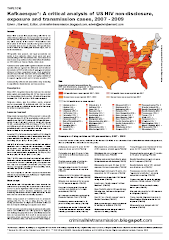
Kafkaesque: A critical analysis of US HIV non-disclosure, exposure & transmission cases, 2007-2009
This poster presented to the XVIII International AIDS Conference in Vienna in July 2010, highlights how the US criminal justice system routinely breaches international human rights standards [click on the image to download an interactive pdf file]
Visit these links to other pages on my blog to read more about....